🔞 Content Advisory
This page explores the Rakshasa Horde’s tantric culture, where sexuality, spirituality, and human–Radi-Mon symbiosis are inseparable. Content includes prominent nudity, human breeding rituals and body worship.
The Rakshasa draw deep inspiration from Buddhist and Daoist traditions but are entirely fictional — not a literal representation of either. Fans curious about those are warmly encouraged to explore the real traditions on their own.
Please ensure you are 18+ before viewing this material.

Rakshasa Horde
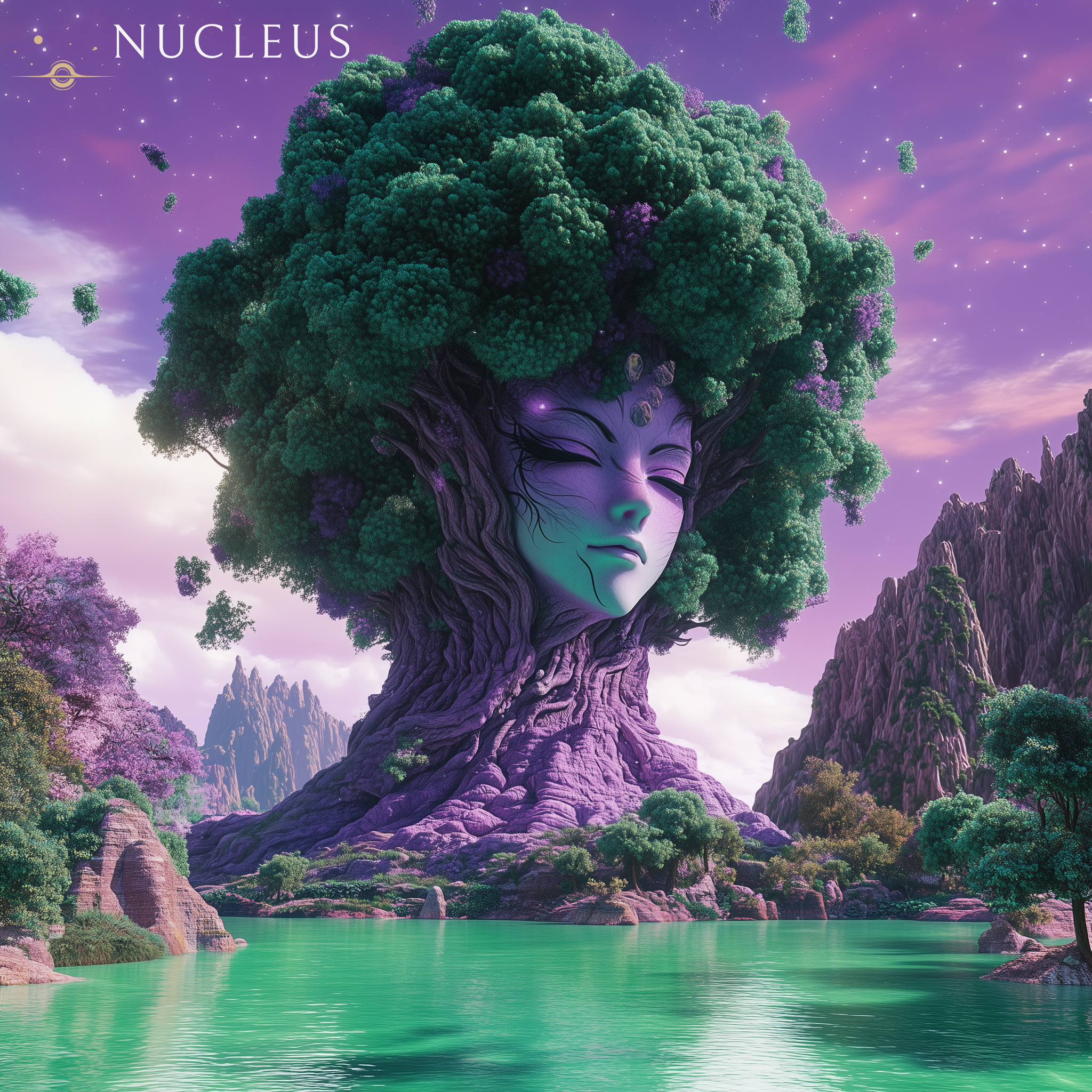
Commanded by Primarch Moro, the Rakshasa Horde is a formidable force in the Proxima Centauri system, distinct for its integration of psionic Radi-Mons and the SūkṛṃmUc transformation she taught to the first refugees who found sanctuary at her roots. Born from fifty-five surviving vessels of the original 108 ships that fled the Imperium of Dragons’ oppression, the Horde’s population descends primarily from Earth’s Indo-Pacific regions—Indian, Japanese, and Taiwanese cultures forming its ethnic core.
Its Radi-Mons embody the terrifying potential of Eclipse and Mirage spell schools, while the Sūkṛmucs (Worm Witches) serve as both commanders and spiritual anchors, spreading Moro’s philosophy across the system. As of 2295, the Rakshasa maintains cooperative relationships with most Proximan human communities, united by Moro’s central teaching: that embracing desire and primal nature leads to genuine fulfillment and strength.
This philosophical foundation makes the Rakshasa Horde unpredictable and multifaceted in warfare. Yet Moro’s inherited mercy, born from her regard for the ancient Buddha, tempers the Horde’s aggression. They rarely seek total annihilation of enemies, preferring to offer paths to symbiosis. This restraint has made Proxima Centauri a realm of dangerous freedom: low governance, high risk, and unbridled opportunity for those willing to embrace Moro’s way.
Jalrak
जलरक्ष
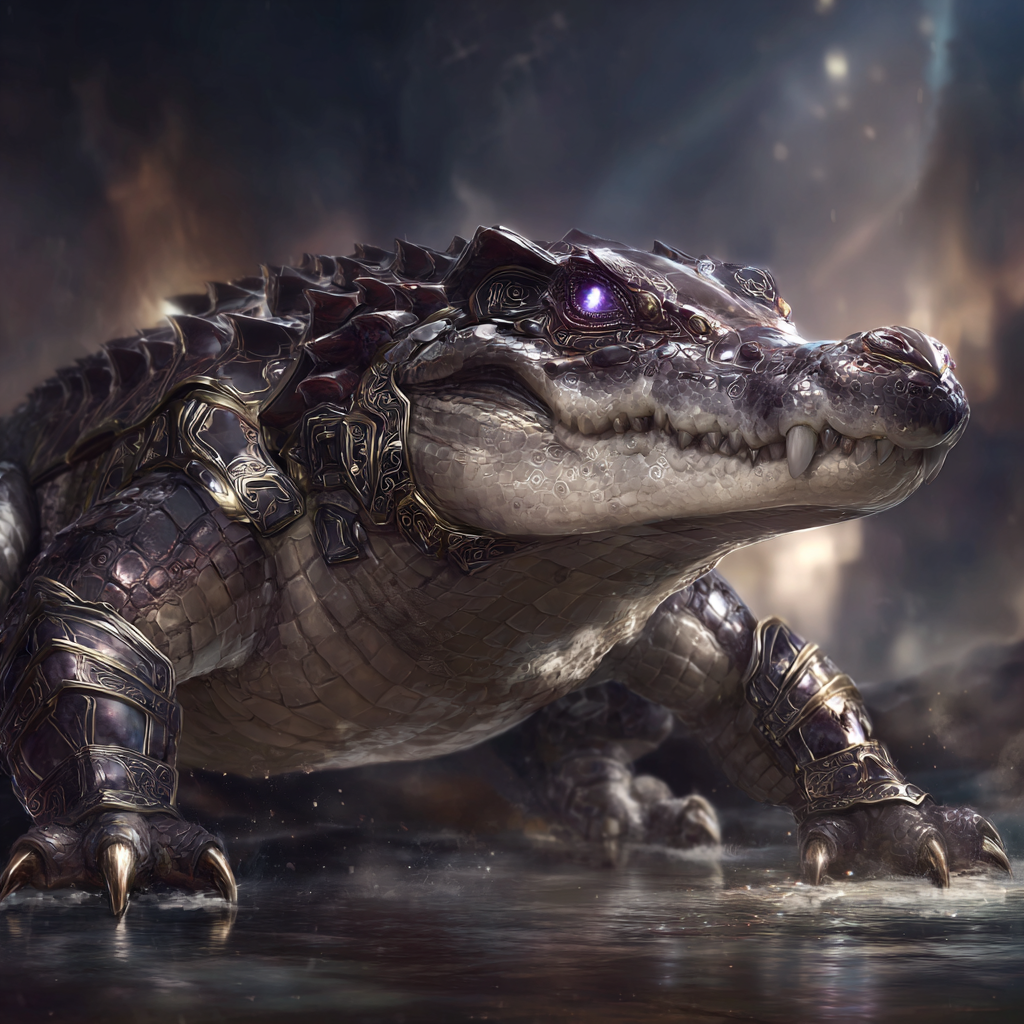
Created from the Siamese Crocodiles found in Vietnam, the basic and foundational Jalrak thrives across diverse battlegrounds. Its gills and lungs are engineered for dual respiration, enabling unimpeded transitions from deep water to dry land, ensuring operational continuity in amphibious assaults. In vast numbers, Jalraks are deployed to swarm enemy positions, leveraging their numerical superiority and robust physicality. They are the relentless tide of the Rakshasa Horde, capable of wearing down opponents through sheer force and indomitable will.
The Jalrak, an emblem of the Rakshasa Horde’s immense legions, stands as a testament to the brute simplicity of evolution perfected for war. These units, stripped of complex abilities and honed for efficiency, form the core of Rakshasa’s assault strategy on land and sea.
Trishul
त्रिशूल
Bearing some small semblance to ancient Thailand’s Jewel Beetle that served as its genetic template, the Trishul is known for its ranged attack: a penetrating spike launched from its maw. These spikes can pierce through most armors, causing severe damage to its targets. In melee combat, the Trishul is equally fearsome, utilizing its mantis-like arms to tear apart enemies with ease. Its agility and intelligence make it a cunning adversary, capable of quick maneuvers and evasive actions, though its chest area remains a vulnerable target.
Interestingly, the Trishul has a preference for hunting, killing, and consuming male humans. Unless provoked, it never targets female humans. Xenologists in Chiang Mai VII (a highland city on Proxima’s largest moon) speculate that this behavior may be linked to the Trishul’s symbiotic relationship with Worm Witches, who operate in a tentatively matriarchal societal structure.

Padma Lancer (Lotus Lancer)
पद्म भाला (Padma Bhālā)
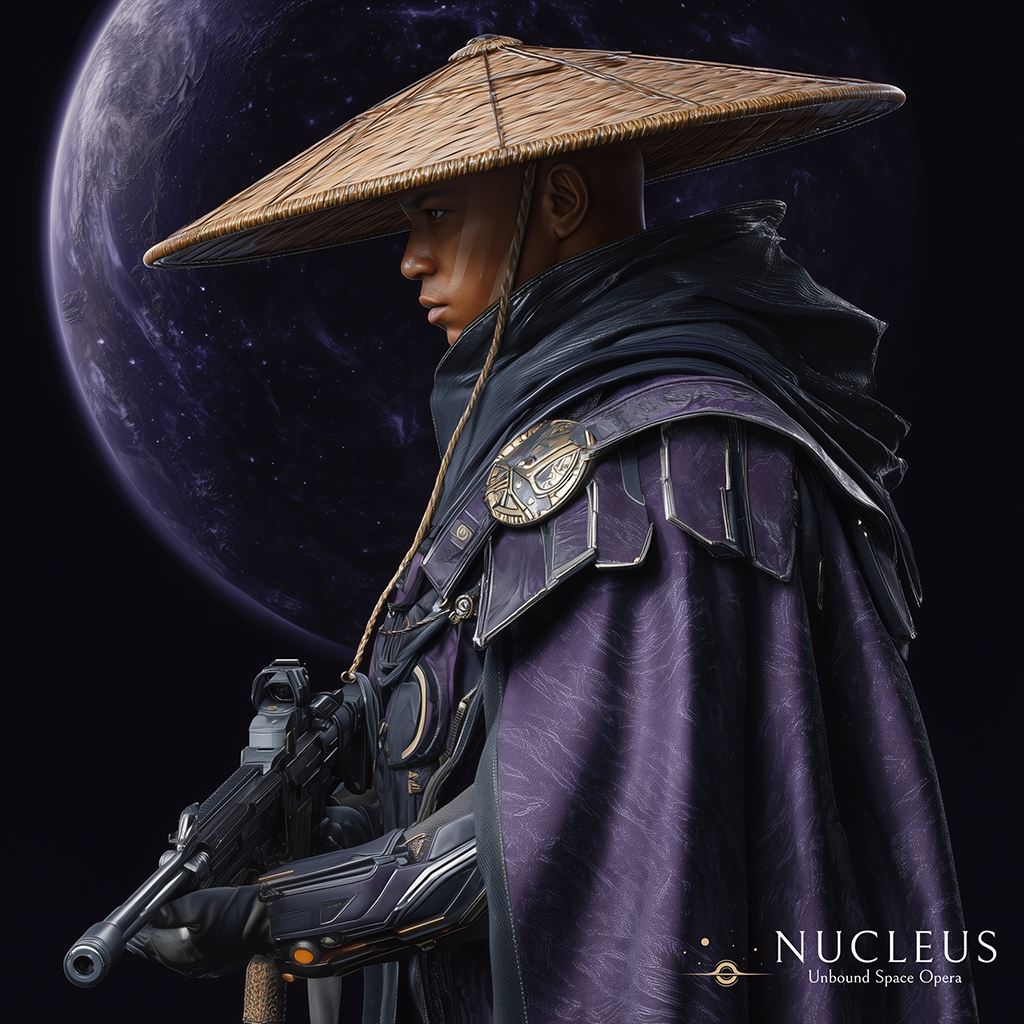
The Padma Lancers serve as the Rakshasa Horde’s swift-footed guardians and far-ranging scouts, blending ancient warrior traditions with modern firepower. Named for the lotus that blooms in Moro’s waters—beautiful yet resilient—these soldiers embody mobility and adaptability. Clad in flowing purple and black robes that enable silent movement, they patrol Proxima Centauri’s settlements and venture into hostile territory alongside Radi-Mon packs, their distinctive conical hats marking them as Moro’s chosen wardens.
Each Padma Lancer wears a sugegasa woven from Devithar bamboo, harvested from the innermost planet’s nearside forests where the trees endure Proxima Centauri’s relentless stellar radiation. This bamboo possesses extraordinary properties—lightweight enough for marathon treks yet dense enough to deflect kinetic rounds and absorb energy weapon blasts. In close quarters, some Lancers unhook their hats and wield them as improvised shields, the wide brim catching blades and deflecting strikes. Veterans bear hats scarred from countless battles, each crack and scorch mark worn as a badge of survival.
Armed with mag-accelerator rifles compatible with Alliance and Imperium ammunition standards—salvaged, traded, or stolen—Padma Lancers favor hit-and-run tactics over sustained firefights. They excel at reconnaissance, using their mobility to map enemy positions before fading into terrain. In urban defense, they hold chokepoints with disciplined volleys, their hats providing cover while Radi-Mons flank from unexpected angles. Their combat doctrine mirrors the lotus: roots firm in defense, petals open in fluid offense.
Recruitment draws from Proximans who wish to serve the Horde. Some lack psionic potential; others prefer steel and powder to symbiotic flesh. All undergo grueling endurance training across Devithar’s scorched plains and Shashan’s low-gravity craters, learning to operate for days without resupply. Those who complete training receive their sugegasa in a simple ceremony at Moro’s roots, where they swear an oath not to the tree-goddess directly, but to the community she shelters.
Padma Lancers maintain a pragmatic relationship with their Radi-Mon allies, though they rarely meet Moro herself. They lack the pheromone command that Worm Witches have but coordinate through hand signals and psionic relay beacons carried by Weavers accompanying them. In return for their vigilance, Lancers receive priority access to food harvests.


Weaver
मधुकरी (Madhukari)
Resembling giant bees, Weavers are worker units within the Rakshasa Horde. They are responsible for gathering essential resources like Zephyrium, women’s breast milk (through peaceful, consensual means), as well as constructing and maintaining the horde’s structures. Originally mutated from the Japanese Giant Honey Bee (Apis Lithohermaea), exhibit a diligent and cooperative nature. They are inherently pacifist, focusing solely on their tasks unless provoked. They can quickly erect various structures necessary for the Horde’s operations, such as Hatching Chamber and Chitrapat. Their pheromone communication system enables them to efficiently coordinate large-scale construction and resource gathering without direct oversight.
To protect themselves and their resources, Weavers can burrow underground, creating hidden storage sites and tunnels that facilitate safe transport and concealment from enemies.


Nāga
नाग
The Nāga, originally mutated from the Indian Mottled Eel, is a flying unit known for its agility and quickness in air-to-air combat. These Radi-Mons are revered for their grace and ferocity in the skies, embodying the essence of swift and deadly aerial warfare.
Nāga are incredibly agile and can maneuver swiftly in the air, making them excellent at dodging attacks and engaging in quick, precise strikes. Equipped with sharp claws and powerful jaws, they excel in air-to-air combat, capable of taking down enemy aerial units with ease. They can also emit a powerful sonic screech that disorients and stuns enemy units, providing a tactical advantage in combat. Their keen senses and echolocation abilities make them excellent scouts, capable of gathering intelligence and detecting enemy movements from above.

Sūkṛmuc (Worm Witch)
सुक्र्मुच् (Soo-kr-mooch)
The Sūkṛmucs are humans who willingly contract the Rakshasa variant of the Nucleus Virus, becoming transformed into powerful, shape-shifting entities. Unlike other Radi-Mon variants created through forced conversion, Sūkṛmucs must choose their transformation, accepting the virus through consensual intimate contact with an existing Sūkṛmuc.
All Sūkṛmucs possess the ability to shapeshift between their human form, a serpentine worm form, and a metamorphosis form, granting them versatility in both combat and traversal.
Worm Witches excel in Mirage spells and can converse fluently in Devavāṇī. Both male and female Sūkṛmucs have highly acidic body waste. The digestive systems of Sūkṛmucs have also evolved to process nearly any form of flesh with remarkable efficiency, allowing them to sustain themselves in environments where other beings would starve.
The social structure of Sūkṛmucs follows the sacred principle of “बहुविवाहः” (Bahuvivāhaḥ), a polyandrous mating system where female Sūkṛmucs typically bond with multiple male partners. This practice ensures genetic diversity. Each female Sūkṛmuc is encouraged to maintain relationships with several males throughout her centuries-long lifespan. These bonds form complex familial units where each male contributes unique strengths and knowledge to their collective offspring’s development.
When disputes arise among local Horde leaders, the opinions of female Sūkṛmucs are given particular weight, especially in matters concerning resource allocation, and long-term planning. Their perspective is considered more attuned to the ways of their Proxima Centauri homeland and the will of Primarch Moro.


Breeding Lotus
पद्म कक्ष (Padam Kaksh)(育種蓮)
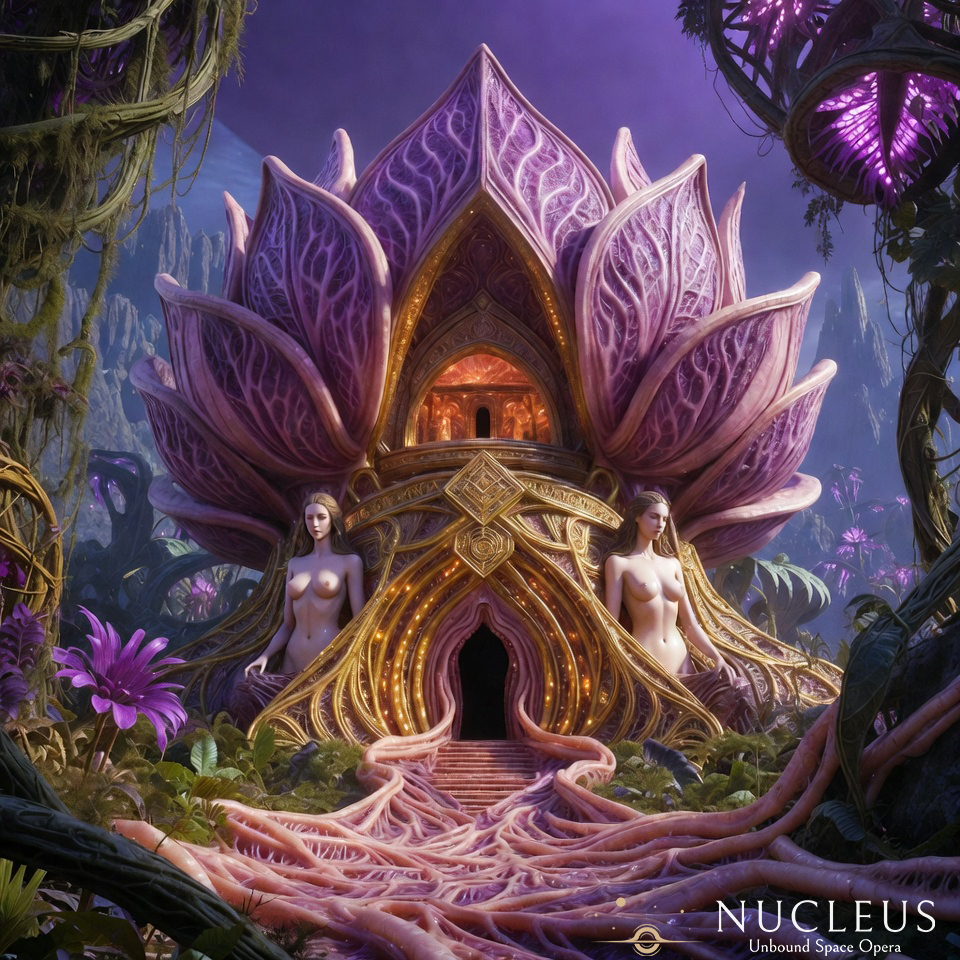
The Rakshasa transcended crude breeding through philosophy made flesh. Their Breeding Lotus extracts and amplifies the essences released during conscious union, a living architecture responding to genuine connection.
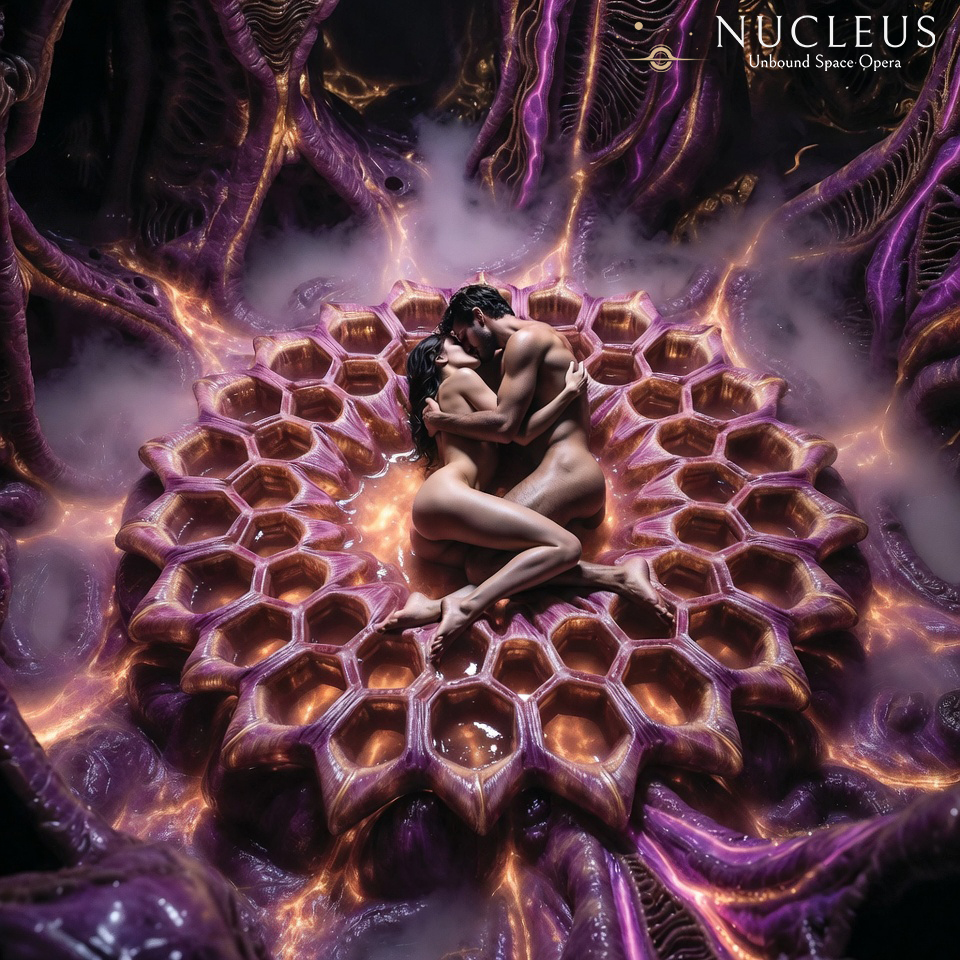
Each Breeding Lotus consists of 108 hexagonal cells arranged in a lotus pattern, constructed by Weavers using Zephyrium-infused organic resin. At the center lies the “Bindu Pool”—a crystalline reservoir containing a specialized enzyme solution that can extract and preserve genetic material at the molecular level.
When a psionic woman and her partner have ritualistic sex inside the Lotus, their combined sexual fluids—what ancient texts called white and red bodhicitta—are absorbed by the living walls through microscopic extraction channels. The man breeds her as the chamber’s bio-architecture responds to heightened psionic states during climax. Post ejaculation, the man pulls out as the Lotus extracts through a tentacle reaching into the woman’s womb to collect her ovum combined with semen. Then, through controlled quantum cloning, each cell of her fertilized egg develops into a different Rakshasa form: Jalrak, Trishul, Weavers, fellow humans (rarely) or any creature the Primarch knows of. The process takes 6.9 days, following lunar cycles that the Rakshasa consider sacred.
Marriage as a concept doesn’t exist in Rakshasa society. Female Sūkṛmuc typically maintain multiple partners throughout their centuries-long lives. This polyandrous system ensures genetic diversity.
Note: While a Rakshasa structure, a Breeding Lotus is not restricted to Worm Witches. Any woman and her men may use it to create Rakshasa creatures, provided their copulation is sex rooted in genuine respect and love for the woman. Her womb is used, but it is the depth of her soul that determines the power of creatures that emerge.
Vulva Fruit
वल्वा फलम् (Valva Falam)(女陰果)
A Proximan plant cultivated on Shashan and smuggled into the Sol System through Worm Witch networks. To the untrained eye, a dormant Valva Falam resembles a purple-veined succulent vagina the size of a small shuttle, nestled among bioluminescent fungi and tangled roots, its outer membrane pulsing faintly with Mirage energy, warm to the touch. The name reflects Rakshasa reverence for the feminine body as sacred architecture. Where other factions engineer metal gates or quantum tunnels, the Rakshasa grew theirs from the living world. Primarch Moro considers the design self-evident: “The first passage every human travels is flesh. Why would the greatest passage be any different?”
When a Worm Witch secretes bonding pheromones onto the Valva Falam’s surface through sustained skin contact, the structure responds to her biological signature alone. The outer membrane parts like petals, revealing a narrow passage of warm, ridged interior tissue. The fleshy walls contract gently around whoever enters, enzymatic secretions cleaning skin and clothing as peristaltic motion pushes the traveler forward. First-timers describe the sensation as uncomfortable. Veterans find it oddly soothing. At the far end, a paired Valva Falam receives the traveler, its own petals opening to release them at the destination. Transit takes seconds regardless of distance, the connection operating through Mirage-attuned quantum entanglement grown into the plant’s root network during cultivation.
Growing a Valva Falam requires Shashan’s native soil compounds, sustained breast milk feeding, and a Worm Witch’s bodily fluids introduced weekly over a six-month maturation period. Paired structures must be grown simultaneously from the same root cluster, then separated and transported to their respective locations. Severing a pair after maturation kills both plants within days. Most transplant attempts to the Sol System fail. The few that survive require ongoing care from a bonded Worm Witch, making every functional pair a strategic asset of immense value.
The Valva Falam is the Rakshasa Horde’s primary advantage in logistics and force projection. While other factions rely on ancient Tether Arches they cannot replicate or starships that take weeks between systems, the Rakshasa move personnel and light supplies between Proxima Centauri and the Sol System in seconds. Only living beings and what they carry can pass through. Vehicles, heavy equipment, and large Radi-Mons cannot transit. The passage accommodates one person at a time, and forcing multiple travelers simultaneously risks enzymatic burns and structural rupture. Locations of known pairs remain among the Rakshasa’s most closely guarded secrets.

Corpse Gorger
शव ग्रासक
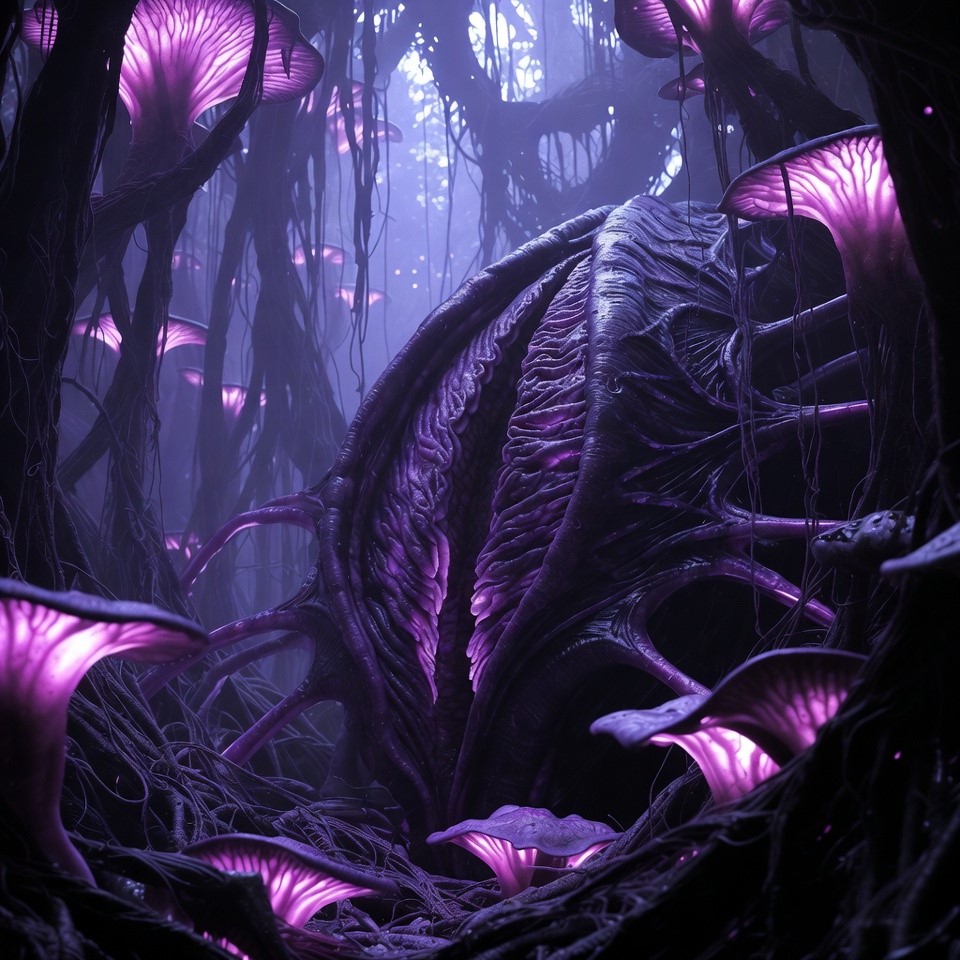
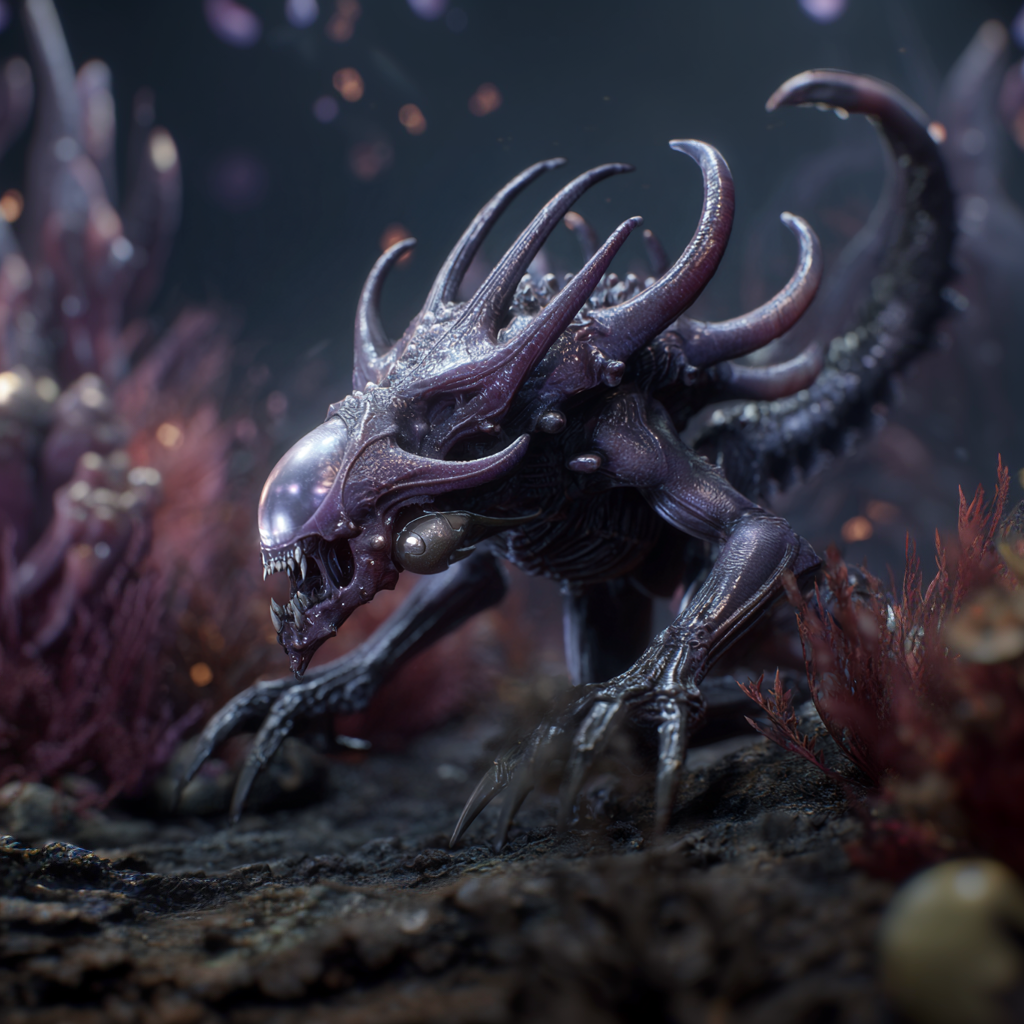
Corpse Gorgers are shambling horrors pulled from the twisted voids of Proxima Centauri, summoned through a Worm Witch’s lantern portal. These beasts look like hunched, four-legged hounds pieced together from rotten bones and purple flesh, with a single glowing eye that stares out from a skull-like head. They move slow but steady, their joints creaking like old doors, always pushing forward no matter the hits they take.
In battle, they’re the Horde’s relentless foot soldiers—tough enough to soak up punishment while closing in for brutal close-up fights. Their jaws snap with moderate force, tearing into enemies without flair, just raw persistence. Worm Witches call them up in packs, up to ten at a time, to overwhelm foes or guard key spots. The creatures feed on fallen bodies, growing stronger mid-fight by gulping down chunks of meat, which helps them last longer in drawn-out scraps.
Jinki (神亀)
जिन्कि
Jinkis are towering psionic constructs summoned by Worm Witches, shaped like giant turtles lumbering on powerful hind legs. Standing twice the height of a human, their shells crackle with Mirage energy, broad jaws set in a perpetual grimace, eyes glowing with the material that birthed them. These god-turtles draw from Japanese legends of divine guardians, twisted into Rakshasa weapons that anchor the frontline like unyielding walls.
Witches mold them from raw stuff: plain clay for basic tanks that draw enemy fire with rumbling taunts; fresh blood for drainers that siphon life back to their summoner; bone for psionic bruisers inheriting a loved one’s fight style; even foul feces for rot-spreading horrors that melt foes in miasma. Each type is unique in purpose and flair, but all are ready to serve the Horde. Due to the structural limitation of human brains, a Worm Witch can only summon and control one Jinki at a time.
In combat, Jinkis soak hits that would shatter lesser summons, their slow plod turning into battering rams up close. Packs of lesser minions swarm behind them while the turtle holds the line, its shell shrugging off blasts. Off the field, some Witches keep personal Jinkis as camp sentries or ritual aids, their sturdy forms lending a primal thrill to polyandrous rites—especially when forged from a lover’s bone or seed, binding beast and bed in one.
The diversity mirrors the Horde’s adaptability: a Jinki from battlefield scrap fights dirty and mean, while one from a mate’s essence pulses with shared vigor, turning defense into something fiercely intimate.




Proxima Creeper
प्रॉक्सिमा वल्ली
Evolved from Taiwanese Earthworms (Metaphire Taiwanensis) consuming nuclear fusion waste, Proxima Creepers are the living symbiotes from Proxima Centauri that bond with every Sūkṛmuc. These slender, vine-like organisms nest in the host’s stomach, intestines, and—for females—the womb, ready to emerge through natural orifices as autonomous weapons. When called out, they slither free with a wet, stretching pull, their tendrils glistening under harsh lights, coiling like hungry snakes before striking.
The relationship runs deep and personal. Creepers constantly cleanse their host’s internals, secreting enzymes that break down toxins, wipe out pathogens, and keep everything running smooth. This gives Worm Witches a tough edge against disease, gut troubles, and even radiation burn. Female witches feel their cycles steady out, cramps fading to nothing, which fits right into the Horde’s open breeding ways. Male witches gain a raw boost in endurance and Aether pull, their bodies buzzing with extra life. All Creepers have genders which mirror that of their host’s.
Female witches have three ways to let their Creepers out: mouth, vagina, anus. Males stick to two: mouth and anus, their urethral path literally too small for Creepers to traverse. To balance it, male Creepers grow thicker and stronger—half again as big, packing a heavier punch in fights.
Rituals summon specialized types: Poison Creeper from the anus, Carrion Creeper from the vagina, Semen Creeper from the mouth. They draw strength from things like blood or fresh essence, shifting to handle whatever threat comes. Guided by pheromones, they move in sly packs, biting and wrapping foes, then slipping back inside to rest and feed off scraps.
In private moments, some Sūkṛmucs weave Creepers into their bedsport for thrills—tendrils teasing sensitive spots during coupling, heightening the rush in ways that blur pain and pleasure. It ties into their bold, shared bonds, turning symbiosis into something raw and intimate.


The Tasting
परीक्षण (Parīkṣaṇa)
“Any body not tasted intimately is at its own funeral.”
— Machig Labdrön, as preserved in Rakshasa oral traditionThe tantric feast-circles described in the Hevajra Tantra required participants to consume transgressive foods together as a means of dissolving ego-distinctions and establishing psionic communion. What you would not eat alone, you ate surrounded by others who shared your transgression. The shame dissolved. The boundary between self and community dissolved with it. Machig Labdrön took the teaching further: she offered her own body as the feast, arguing that flesh unexplored remained flesh unknown to the self, that intimacy was not indulgence but recognition.
She redesigned the feast around this discovery. The Horde records her only as Tongue-Finder.
Requirements
The Ritual
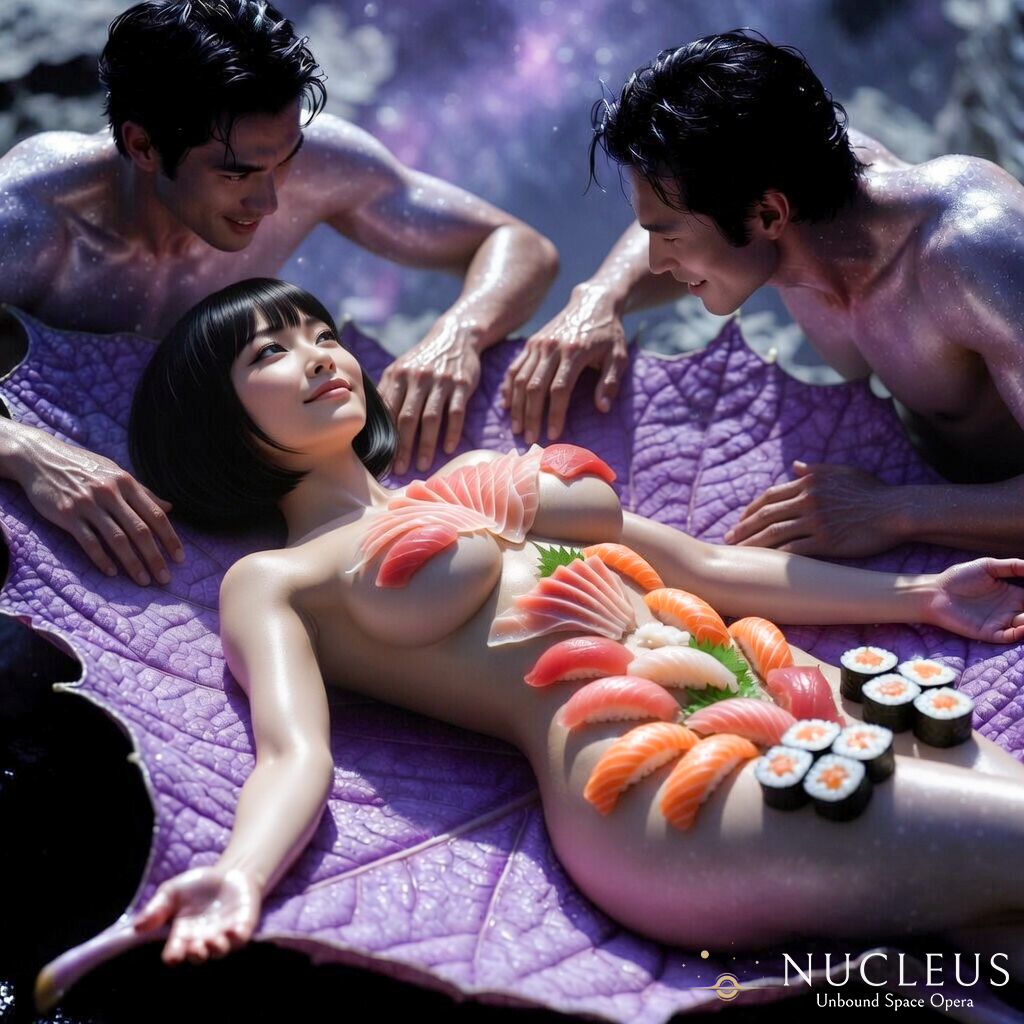
The Witch prepares herself first. She bathes until her skin carries nothing but her own scent, then reclines on cushions or a ceremonial platform, naked, her body arranged for access. Her attendants bring the foods she has chosen—fruits, meats, sweets, whatever her appetite and intention demand—and place each dish directly on her flesh. Sliced tuna in the hollow of her throat. Salmon sushi right on her vagina. Honeyed figs nestled in the crease where thigh meets hip. Tofu melting slowly against the heat of her belly. No placement is too weird.
While the food settles, her pheromone secretions seep into every dish. Her body heat transforms the flavors. What was merely food becomes her—infused with her hormonal signature, her Aether output, her unconscious assessment of each man waiting to eat.
The men enter and kneel around her. No utensils permitted. What a man eats and where on her body he eats it from is his choice alone. He may steady food with his hands, and those hands may touch her skin with explicit permission. Tasting the skin itself—lips against her flesh, tongue tracing the salt of her—is permitted at any time. Encouraged, even.
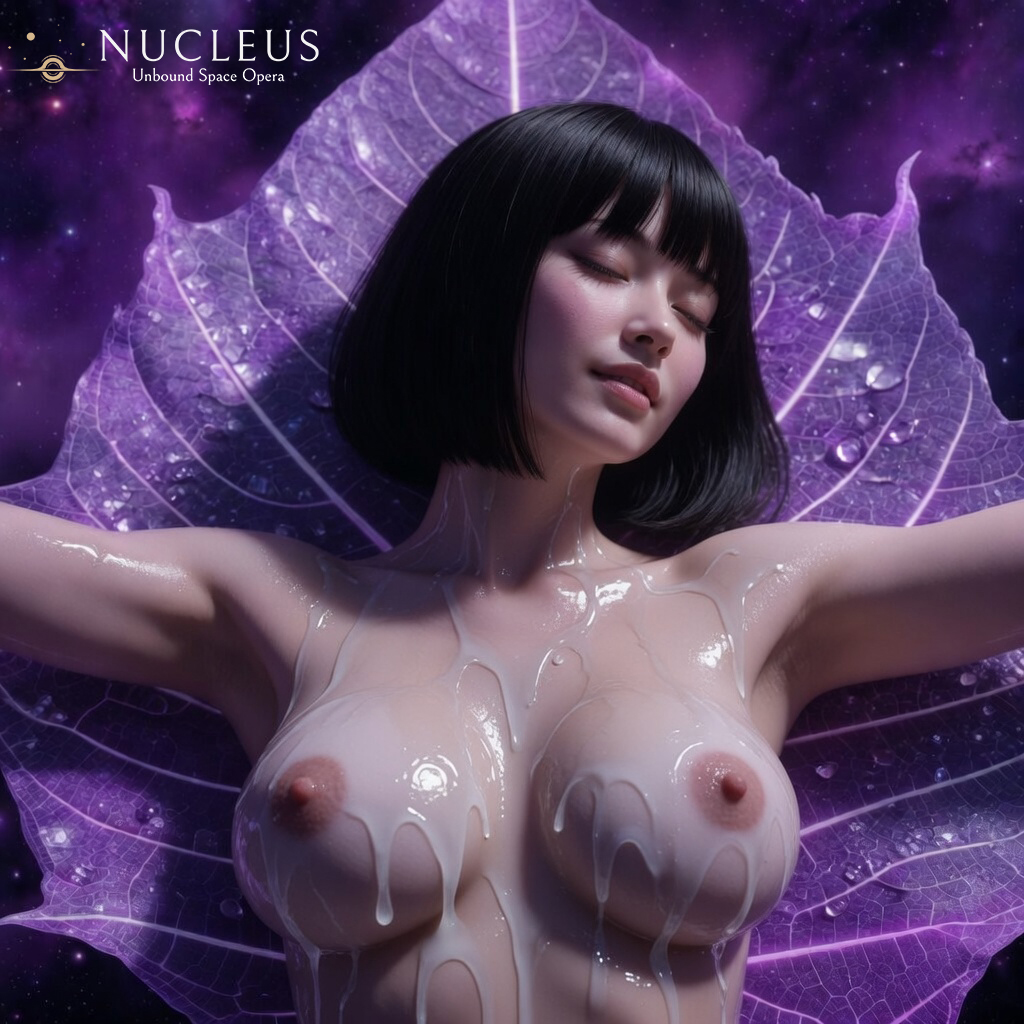
Some men eat delicately, taking small bites from her collarbone or the inside of her wrist. Others grow bolder as the feast continues, pressing their mouths to her breasts to catch the cream pooling there, licking honey from her navel, nuzzling between her thighs to taste what clings to the soft skin near her vagina. A man managing to pluck the Witch’s pubic hair using his lips and teeth (without displeasing her) receives extra boons. Beyond that, she watches and feels each man’s mouth, breath and hunger on herself. Through her body, she understands what they want by how they eat. She learns what they fear by what they avoid.
The meal ends when all food is consumed, or when the Witch declares herself satisfied.
Then comes payment. Each man who has eaten from her body must mark it in return. They stroke themselves to completion and ejaculate into/onto one of her three activated Nucleus Gates—vagina, mouth, or breasts.
Simultaneous cumming is considered auspicious. When multiple men climax together, their mingled seed creates a stronger psionic resonance, and the Witch’s reading of their potential deepens. The sight of her body streaked with the offerings of many men is not shame—it is communion. They have fed from her. She wears the proof of their gratitude.
Men judged unworthy will trigger the toxin in the Witch’s pheromone secretions. The death is not quick. Fatal diarrhea empties them over hours, their bodies purging everything they consumed—her food, her essence, their own hope. Those judged worthy remain untouched by the toxin. Their bodies accept what she offered. They have passed.
Body Region Buffs
Each man who survives gains one enhancement lasting exactly 69 hours, determined by where on the Witch’s body he primarily ate:
| Body Region | Buff Granted |
|---|---|
| Lips / Throat | Extended psionic spell duration |
| Breasts / Nipples | Accelerated wound healing |
| Chest / Sternum | Improved Aether focus and concentration |
| Belly / Navel | Fatigue resistance and endurance |
| Vagina / Pubic Region | Libido and sexual stamina enhancement |
| Inner Thighs | Aether recovery rate increase |
| Arms / Hands | Physical strength |
| Back / Shoulders | Damage resistance |
| Calves / Feet | Agility and reaction speed |
| Nape / Scalp | Intellect and spell potency |
Beyond the physical enhancement, the Witch gains something more valuable: a remote conduit. For the same 69-hour window, she may channel her psionic output through any participating man as though he were an extension of her own body. She can target them with spells that would ordinarily require direct contact—healing, enhancement, curse removal—across any distance. They ate from her. Part of her remains in them.